 Tower Academy.
On Tuesday, 3 November, millions of Americans will go to vote. But wait - wasn't the big presidential election two years ago? It was. This one is different. It's called the midterms, and it can change a lot in Washington - even though the president's name isn't on the ballot.
Here's a short, simple guide - with the animals, the colors, a few surprising facts and the words you'll hear on the news all week. 🇺🇸
🗳️ What are the midterms?
An American president serves a four-year term. The midterm elections happen in the middle of that term - two years after the presidential election. That's where the name comes from: mid (middle) + term.
This year, Americans choose:
- all 435 members of the House of Representatives (they serve only two years),
- about one third of the Senate (there are 100 senators, two for every state; they serve six years, so only some of them face voters each time),
- governors in 36 states, plus thousands of local officials - mayors, judges, even sheriffs.
The House and the Senate together are called Congress. Congress writes the laws, so if the president's party loses a majority there, the next two years can be much harder for the White House.
And that happens a lot. The president's party almost always loses seats in the midterms. Since 1934, it has won seats in the House only three times: in 1934, 1998 and 2002. Political experts even have a name for it - the "midterm curse".
🐘🫏 The elephant and the donkey
America has two big parties, and each one has an animal mascot.
The Democrats - the donkey. In 1828, the opponents of Andrew Jackson called him a "jackass" (an old word for a male donkey - and today a rude word for a stupid person). Instead of getting angry, Jackson put a donkey on his posters. He said it was stubborn and hard-working, just like him. He won.
The Republicans - the elephant. In 1874, the cartoonist Thomas Nast drew a big, nervous elephant labelled "The Republican Vote" in the magazine Harper's Weekly. Readers loved it, and the elephant stayed. Nast also made the Democratic donkey famous - so one man gave America both of its party animals!
You'll also hear the Republicans called the GOP - the Grand Old Party. Funny thing: the Democratic Party is actually older (it dates from the 1820s, the Republicans from 1854).
There are smaller parties too - the Libertarians, the Greens and others. They're called third parties, and they almost never win seats in Congress, because in most places only the candidate with the most votes wins.
🔴🔵 Red and blue
On American TV maps, Republicans are red and Democrats are blue. So a red state usually votes Republican and a blue state usually votes Democratic. The really exciting ones are swing states - places where either party can win.
Fun fact: these colors are quite new. For decades, TV channels used different colors every year - sometimes the Republicans were blue! The colors only "stuck" after the 2000 election, when Americans watched the red-and-blue map for five weeks while Florida was recounted. Watch out: in many other countries, including the UK, red is the color of the left, so the American colors often confuse Europeans!
📅 Why on a Tuesday?
In Poland we vote on Sundays. In the USA, Election Day is always "the Tuesday after the first Monday in November". The rule comes from 1845, when most Americans were farmers. Sunday was for church, Wednesday was often market day, and traveling to the town to vote could take a whole day by horse. Tuesday was the best fit - and nobody has changed it since.
It's a normal working day, not a holiday, so many Americans vote early or by mail. In some states, more than half of the votes are in before Election Day even starts!
🤓 More surprising facts
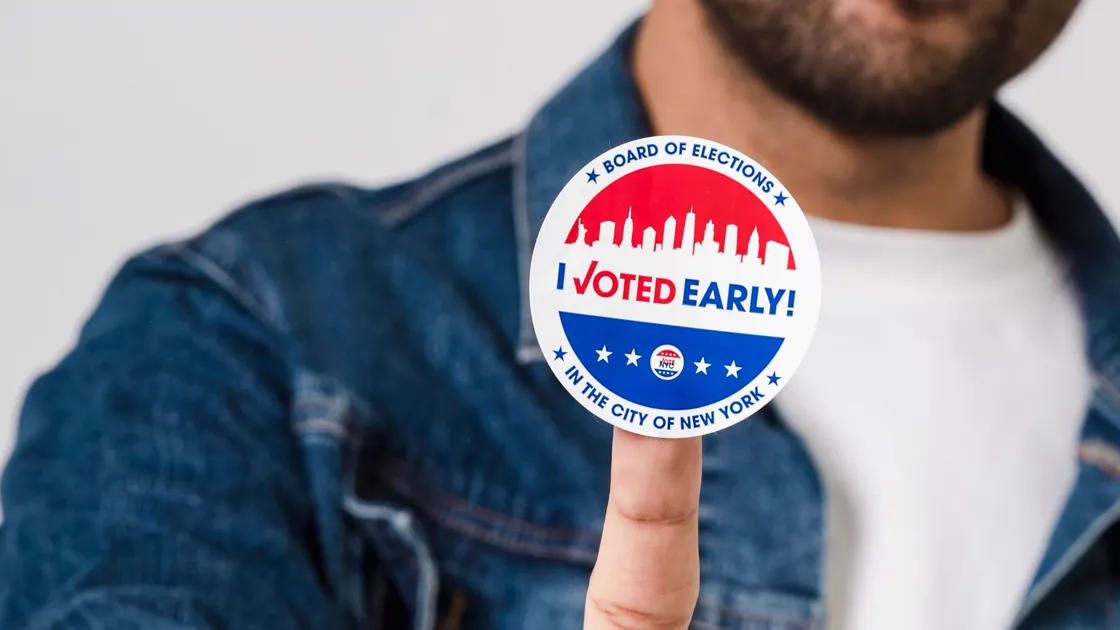
- The sticker. After voting, people get a small "I Voted" sticker and wear it all day. Some cities hold competitions to design it - kids often win.
- Nobody announces the winner officially on the night. TV channels and the news agency AP "call" the races when the numbers make the result certain. The official count can take weeks.
- The capital has no vote. Washington, D.C. has no senators and only a delegate in the House who can't vote on laws. That's why its car plates say "Taxation without representation".
- Voting from space. Since 1997, American astronauts on the space station can vote - their ballot is sent by email from orbit. 🚀
- Yes, sheriffs. In most American counties, the chief of police (the sheriff) is elected by the people - in Poland, nobody votes for a police chief!
📺 Election night English
Turn on CNN or the BBC on Tuesday night and you'll hear these:
run for (office) - try to get elected.
She is running for the Senate in Georgia.
an incumbent - the person who has the job now and wants to keep it.
Most incumbents win again.
a polling station (BrE) / a polling place (AmE) - the place where you go to vote.
There was a long line outside the polling place.
turnout - how many people actually vote. In Polish, frekwencja - and remember, the English word frequency means something completely different!
Turnout in midterm elections is usually lower than in presidential years.
an exit poll - a survey of people leaving the polling station.
The first exit polls come out when the polls close.
too close to call - the results are so close that nobody can say who won yet.
At midnight, the race in Arizona was still too close to call.
flip a seat - win a seat that the other party had before.
Democrats need to flip only a few seats to win the House.
a landslide - a very big win.
He won by a landslide - almost 70% of the votes.
concede - officially accept that you have lost.
The candidate conceded and congratulated her opponent.
gridlock - a situation where nothing can move. Literally about traffic, but in politics it means the two sides block each other and no laws get passed.
Many experts expect two years of gridlock in Washington.
a lame duck - a politician who is still in office but has lost power, for example because their time is almost over.
After the election, the old Congress becomes a lame duck until January.
Quick quiz
Complete the sentences with one word.
- The result is too close to ______ - we'll know tomorrow.
- Only 40% of people voted. The ______ was very low.
- She won by a ______ - her opponent got only 25%.
- He lost, but he didn't want to ______ for three days.
- Ohio was a swing ______ for many years.
- The Republican Party has an elephant as its ______.
- Republicans won the seat in 2024, but this year Democrats hope to ______ it.
Show answers
- call
- turnout
- landslide
- concede
- state
- mascot (or symbol)
- flip
Your turn!
Sunday or Tuesday - which day is better for an election, and why? And if your town had a party animal, what would it be? Tell us in the comments - in English, of course! 👇 (No politics fights, please - just the words. 😉)